The Story of Fabrics
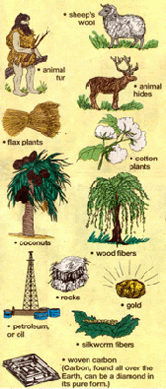
 Take a look at the clothes you are wearing. Clothes are made from fabrics, or textiles. People have made textiles from:
Fabulous Fabrics
 Flax
Flax
Flax is probably the oldest natural fiber to be made 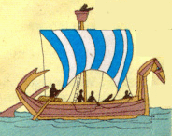 into fabric. It is used to make linen. The strands of the flax plant are like the stringy bits of celery. Because the fibers are very strong linen does, not tear easily. For thousands of years, people used it to make clothes and things needing extra strength, such as sails. Early ocean voyages might have been impossible without it.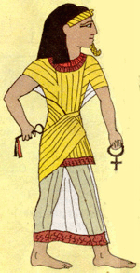
Cloth of gold
The pharaohs of ancient Egyptwore garments made with thin threads of beaten gold. Some fabrics had up to 500 gold threads per one inch of cloth. Not even the very finest Chinese silk had this many threads. Egyptian slaves spent hundreds of hours tapping out gold to make fine threads no thicker than a hair.
Asbestos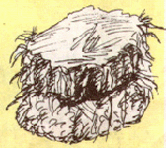
Asbestos (as-BES-tuhs) is a mineral found in rocks. When the rocks are broken apart, it is easy to pull the asbestos into fibers.
It is special because it does not burn. It has been used in thousands of ways including, for firefighter's clothing and airplanes.
However asbestos can cause serious health problems to people that mine it or make thinks with it. If people breathe it in, it can choke their lungs or cause cancer.
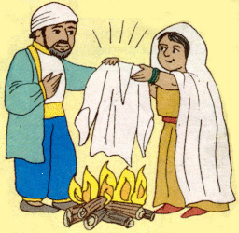 People have been making cloth out of asbestos for thousands of years. Ancient Egyptians wrapped dead bodies in it before burial. About 1,000 years ago and present day people in areas of Afghanistan, Iraq and Iran wear asbestos clothing. They didn’t wash their clothes in water; they threw them in fire to ward off the dirt and it left the cloth clean.
History Making Fabrics
Silk was so important that it changed the course of history. Other fabrics have played a role in history too.
Silk is a beautiful, soft, shiny fiber that can be dyed in rich colors. It is lightweight and warm, and the strongest natural fiber.
About 5,000 years ago, a queen in China discovered how to make silk from silkworm cocoons. For about 3,000 years, the Chinese kept her discovery a secret.
The silkworm’s cocoon is made of fibers hundreds, of feet long. Chinese women put the cocoons in hot water to loosen the silk strands. Then they pulled out the long strands and wound them onto a bamboo cane.
They had to be very, very patient.
Silk copies
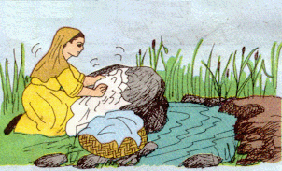 Because, poor people could not, afford real silk, they tried to make other cloth look silky. Women beat on cotton with sticks to soften the fibers. Then they rubbed and rubbed it against a big stone to make it shiny.This shinny cotton was called chintz. Because chintz was a cheaper copy of silk, calling something chintzy means it is cheap and not of good quality.
The Silk Road
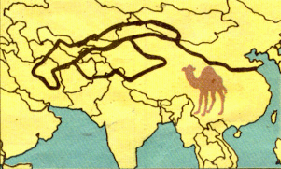 Merchants traveling the Silk Road had to travel for months across harsh lands. They had to deal with bandits, scorching deserts and mountain blizzards.
Because silk was so beautiful, and the Chinese were the only ones who knew how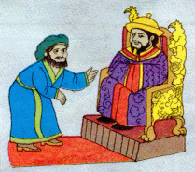 to make it, it was very valuable.
It was so popular in the Roman Empire that it was against the law for men to wear silk clothes. The Roman emperor thought people were paying too much money for it.
Several roads from China to the Roman Empire were built to handle the silk trade. These became known as the Silk Road.
In exchange for their silk, Europeans traded the Chinese such things as horses and glass.
People also shared ideas. Buddhists' brought their religion from India to China across the Silk Road.An Italian explorer, Marco Polo, traveled across the Silk Road from Italy to China in the late 1200s.
He gave Europeans their first eyewitness report on China including paper making one of the Chinese inventions.
He told about wonders, such as the use of coal (which Europeans didn’t know about), baths with hot and cold running water and kites that could carried men into the air. His stories were so amazing that at first no one believed them. They wanted to see for themselves. The Silk Road opened doors between two very different cultures.
Cotton
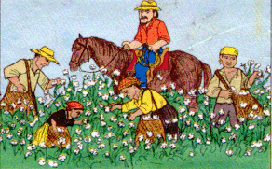 Cotton comes from the cotton plant. It can be strong enough for blue jeans or soft enough for baby clothes. The Aztecs were growing it, 8,000 years ago in Mexico.
In 1793, Eli Whitney invented the cotton engine, or gin. It separated cotton fiber from seeds about 50 times faster than humans could. Cotton growers could now make more money than ever, so they wanted to plant more and more.
Raising cotton took a lot of workers. As growers planted more cotton, they needed more workers. In the United States, Southern cotton growers depended on slaves to do the work. Their fight to keep slavery legal was one of the main causes of the Civil War. Raising cotton was back breaking work.
Modem fibers
Rayon, the first human-made fiber, was invented in the late 1800s. Its name comes from "ray", to show. 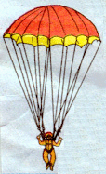 How it shines, and "on" because it is like cotton. It is made from the tough, stringy fibers in wood pulp or cotton stems. These fibers are dissolved in chemicals. Rayon fibers are made from the sticky liquid this makes.
Nylon, made in the 1930s, was first artificial, or synthetic, fiber. Synthetic fibers are not made entirely from plants or animals. They might be made from coal or petroleum. Nylon made with oil and chemicals.
Nylon gets its name from New York and, London, where the first manufacturers were. It is a strong, stretchy fiber used for everything from nylon stockings, to parachutes, to the mesh parts of running shoes.
Closes for Comfort and Protection
How did you pick out the clothes you’re wearing?
You probably thought about what looked good and what was in style. The weather also plays a big part in how you dress.
In warm climates, people might wear long garments that protect them from the sun, but are enough to allow cooling air to flow around the body.
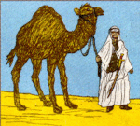
In the hot desert area of the Middle East people wear long robes and head covers to protect them from the sun and blowing sand.
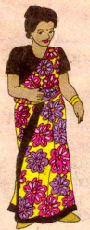
Many Women in India wear saris, or long, flowing dress like garments.
They are made from pieces of fabric about 6 yards long, and are often made of beautiful colored silk.
Women drape them around their bodies in a special way.
In other hot areas, people keep cool by wearing very little clothing.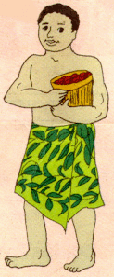
On Pacific islands such as Fiji men may wear a garment called a lava-lava. They do not wear shirts. Women may wear long loose dresses.
In cold areas, people must bundle up to survive the cold. They often wear many layers of clothes to keep in their body heat and keep out the icy cold.
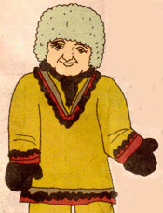
Lapland is the area north of the Arctic Circle. It is one of the coldest areas on Earth. Winter lasts for nine months. The people who live there, the Lapps make part of their clothes from reindeer hides and some from warm wool.
Special types of clothes are designed for certain activities. These clothes offer more protection and comfort than regular street clothes.
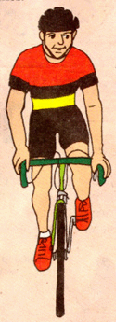
Bike shorts are specially designed forcomfort while riding.
They are padded in the seat.
The tight fit prevents the shorts from flapping around the rider and catching on the seat.
The tight fit also works to cut down wind resistant, which makes the ride easier.
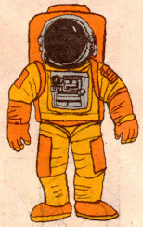
A bike helmet is a must to protect any rider.Clothes protect people in harsh environments. Space suites protect astronauts in very hot or very cold temperatures. Backpacks hold an oxygen supply and radio.
This site managed by Rudy Pristow.
