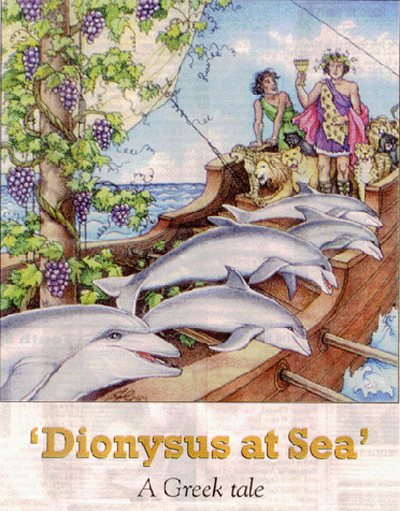
 Long ago in Greece there lived a man named Aco-etes. His father was a poor fisherman who, upon his death, left his only son his fishing rods and lines and wished him a good life at sea. Acoetes taught himself to steer a ship, and he gathered a crew of strong sailors and set out to sea. He hoped to find many treasures in the world.
 After weeks of hard traveling, the crew, needing to rest, anchored on an island far from the coast. At dawn the next day, they awoke and set off to gather food and water. Acoetes waited on board, preparing the sails.
When the men returned, they carried supplies, but they brought something more. They brought along a man bound hand and foot by heavy ropes. "Captain," the men cried, "look what we have found. Surely this young man will bring us much money if we sell him for a slave. Look how strong and fit and fair he is."
The moment Acoetes looked into the captive's eyes, he knew this was no ordinary man. He could see in this man something impossible to describe, but a quality that Acoetes recognized immediately. He knew this was some kind of god.
"Leave him alone," Acoetes said to his men. He felt fearful, and also somehow responsible. He knew they must set this man free. No one, Acoetes understood, could harm a god; no one could toy with one. And certainly no one could capture a god.
But the men, hungry for wealth, ignored their captain. "Think of all we could purchase with the money we would earn," they argued. They gathered around their captain, threatening knock him into the sea if he tried to stop them from keeping their slave.
Acoetes knew he was helpless in the face of his determined crew. And so he raised the "sails, and they set off. Still, Acoetes knew this man would never be a slave.
Acoetes steered out to sea, but the bound young man stood close beside him. "Please," he whispered, his voice urgent, "steer the ship back toward the island of Naxos. Set me free there. I will help you."
Without a moment's hesitation, Acoetes pulled the tiller toward him, tacking into the wind."What's this?" cried one of the men. "We're sailing in the wrong direction." The crew alerted to the change, set upon Acoetes. They ripped the tiller from his hands, pushed him to the deck floor and reversed the ship's direction.
The young man, still bound, fell to his knees. "Please," he begged, "take me to Naxos. You will not regret your decision to give me my freedom."
The men jeered at him. "Slave!" they cried, and on they sailed.
But suddenly the strong, swift winds stopped blowing. The ship was becalmed. "It'll be but a moment," one of the men said, and they waited, but not a hint of wind rose. The sails hung listless as the ship bobbed upon the calm sea.
"We'll row!" another man said, and the crew took the oars and began to row. They were strong men, and they were many, but no matter how hard they rowed, the ship did not budge. There they sat unmoving. The sails did not flutter. The sun beat down. The men grunted and worked the oars, but still the ship sat still on the calmest of oceans.
Furious, the crew rose to tackle their captive, but when they did, strands of ivy began to sprout from the decks. They grew quickly, long and coiled; within seconds the vines twined themselves into thick ropes and twisted around spars, clasped the masts and snaked around the oars, and wove themselves around the crew's limbs.
"Help," cried the men, now trapped in the grasp of these twines, terrified of the stranger's powers. "What have you done to us?"
But the young man simply stood and watched, with a smile upon his face. Only Acoetes remained free. And then another amazing thing happened. Dozens of creatures appeared on deck - wildcats of every shape and size - and they set the young man free from his ropes. Once free the man raised his arm, and the animals lunged at the crew.
The men shrieked, and then, to their surprise, they began to change shape. Their skin grew sleek and gray, their arms stuck to their sides, their backs curved, their noses stretched to snouts, and their feet, bound together, turned into forked tails.
"Help!" they shouted as they were transformed into dolphins, but with the final transformation, they leaped from the ship into the sea, and though some of them tried not to, something great-er than their will pushed them. One by one, each man, changed beyond recognition, leaped overboard. Acoetes was left alone with the stranger.
"You are a god," Acoetes said calmly.
The young man bowed his head. "I am Dionysus, son of Zeus," he said. Acoetes remembered the tale of the man known as the twice-born child. The son of Zeus and the mortal beauty Semele, the man who had been raised by satyrs, who invented wine-making and joyful dance, the man many hoped to destroy, for they did not like the power he held over so many people.
Acoetes brought Dionysus to Greece, and there he went to see Pentheus, who ruled over the land. Their Acoetes told his tale.
"Pentheus," Acoetes said, "it is a warning. Do not harm Dionysus or his followers. Allow him to live free as he will or you will suffer."
Penthesus scowled. He was a proud man and would not heed the foolish tales of a poor fisherman. He did not listen to Acoetes, and lived to regret it, but that is another tale.
This site managed by Rudy Pristow.
